From Olympic Podiums to Community Pools: How Paris 2024 Redefined the Games’ Legacy
From Olympic Podiums to Community Pools: How Paris 2024 Redefined the Games’ Legacy
For decades, the Olympic Games carried a heavy reputation: a spectacle of athleticism followed by a graveyard of white elephants. Host cities would spend billions constructing colossal venues that stood empty within months, draining public funds and leaving communities with maintenance nightmares. But two years after the closing ceremony of Paris 2024, a new narrative is emerging—one that suggests the “City of Light” may have finally cracked the code on sustainable legacy.
According to a comprehensive 2026 report by the OECD, the Paris 2024 Olympics achieved a milestone that eluded Rio, Athens, and even London: 95% of venues were either pre-existing or temporary structures. More importantly, the permanent additions built specifically for the Games are now thriving as integral parts of the local urban fabric, serving residents rather than gathering dust. This is not just a win for France; it is a blueprint for the future of global sporting events.
The 95% Solution: A Radical Shift in Strategy
The guiding principle of Paris 2024 was succinct: “Build less, use more.” Unlike previous hosts that felt compelled to construct entire new complexes, Paris leveraged its existing architectural treasures. The Eiffel Tower hosted beach volleyball; the Grand Palais became the stage for fencing and taekwondo; and the Champs-Élysées was transformed into a cycling track. These were not just cost-saving measures; they were a philosophical statement that the Olympics should adapt to the city, not the other way around.
Only a handful of permanent structures were erected, most notably the Aquatics Centre in Saint-Denis and the Adidas Arena (formerly the Aubervilliers Arena). The strategy here was deliberate: build only where there was a documented, pre-existing deficit in community infrastructure.
“The era of building for the spectacle is over,” says Julien Dubois, an urban planning analyst at the Institute for Sustainable Cities. “Paris proved that you can host the world’s biggest event by addressing local needs first. The Aquatics Centre wasn’t built for the 100-meter freestyle finalists; it was built because the Seine-Saint-Denis district lacked a public pool. The Olympics just provided the funding and the deadline.”
Case Study: The Aquatics Centre
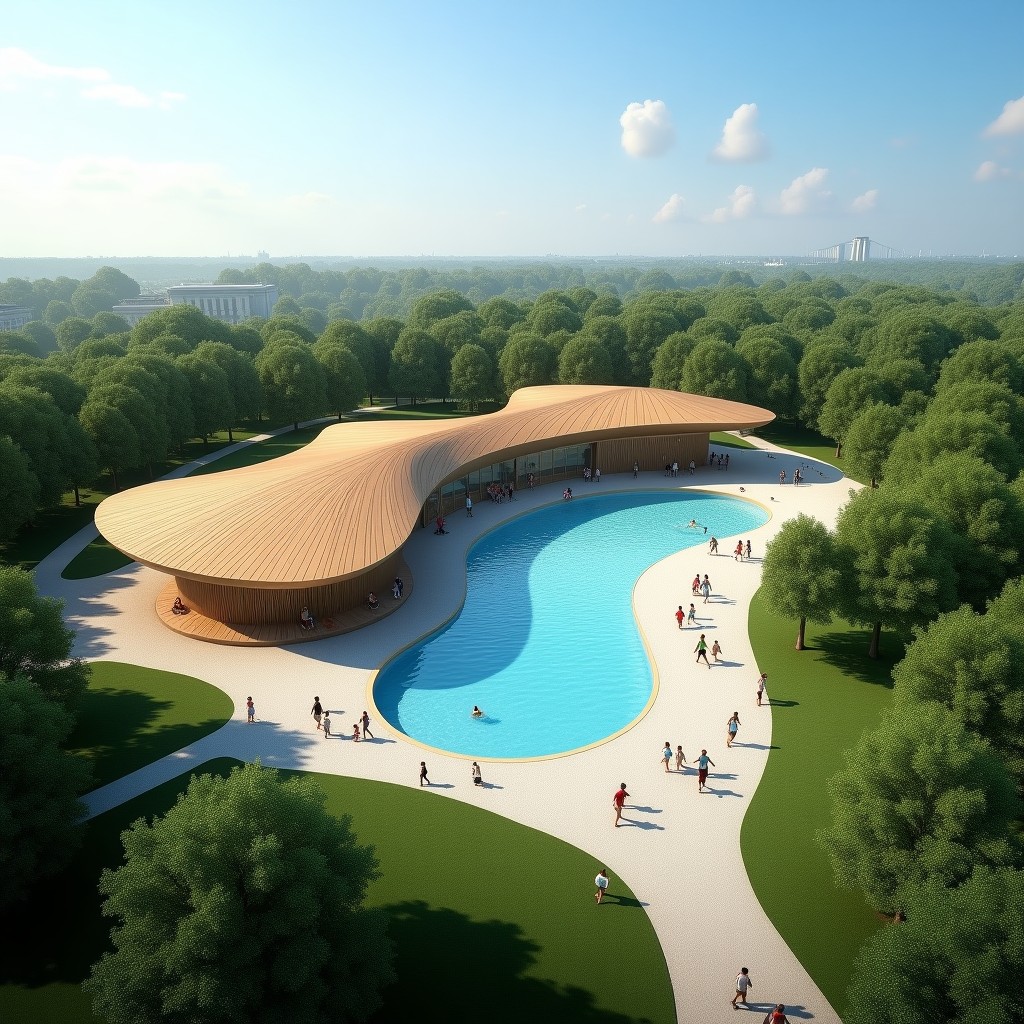
Nowhere is this legacy success more visible than in Saint-Denis. The new Aquatics Centre, with its iconic undulating wooden roof (one of the largest timber structures in Europe), was designed to be a neighborhood hub from day one. During the Games, it hosted diving and water polo. Today, it serves as a public pool for schools, a training ground for local clubs, and a recreation center for families in one of France’s most underserved regions.
Usage data from the first half of 2026 shows the facility is operating at 80% capacity, a stark contrast to the Athens Olympic complex, which sat at less than 10% usage in the years following 2004. The center has become a catalyst for regeneration in the area, attracting cafes, parks, and improved transit links that benefit residents long after the torch has moved on.
Temporary by Design
For events that required specialized venues, Paris embraced ephemeral architecture. The Champ de Mars Arena, which hosted judo and wrestling with the Eiffel Tower as a backdrop, was entirely temporary. Constructed from modular, recyclable materials, it was dismantled within weeks of the closing ceremony, and the materials were repurposed for other public works projects.
This approach significantly reduced the “carbon cost” of the Games. The OECD report highlights that the carbon footprint of venue construction for Paris 2024 was less than half that of London 2012. By avoiding the long-term maintenance burden of unused stadiums, the city has saved an estimated €150 million annually in operational costs—funds that are being redirected into local sports programs and youth development.
Economic Impact: Beyond the Tourism Spike
While the tourism boom during the two weeks of the Games was well-documented, the long-term economic dividends are only now materializing. The infrastructure upgrades—particularly in the metro and RER systems—have permanently improved connectivity for the Greater Paris region. The extension of Metro Line 14 and the modernization of key stations have cut commute times for hundreds of thousands of residents.
Furthermore, the “brand value” of Paris as a host of green, efficient mega-events has attracted new business investments. Several tech firms and international NGOs have cited the city’s successful execution of the Games as a factor in their decision to establish regional headquarters there. The narrative has shifted from “Paris is expensive” to “Paris is capable.”
Lessons for Milano Cortina 2026 and Beyond
The success of Paris 2024 sets a formidable benchmark for the upcoming Milano Cortina 2026 Winter Games. Organizers in Italy are already adopting similar strategies, focusing on using existing ski resorts and temporary structures rather than building new ones in sensitive alpine environments. The “Paris Model” is becoming the new gold standard for the International Olympic Committee (IOC), which has explicitly mandated sustainability and legacy planning as core criteria for future bids.
However, challenges remain. Critics point out that while the venue strategy was sound, the displacement of some homeless populations and the heavy-handed security measures during the Games left a complicated social legacy. True sustainability must include social equity, not just carbon metrics and recycled concrete.
Key Takeaways from the Paris Legacy
- 95% Existing or Temporary: Paris utilized pre-existing or temporary venues for 95% of events, drastically reducing construction waste and cost.
- Community-First Design: New permanent structures like the Aquatics Centre were built specifically to fill gaps in local public infrastructure, ensuring high post-Games usage.
- Carbon Reduction: Venue construction emissions were cut by over 50% compared to London 2012, thanks to modular designs and material reuse.
- Economic Efficiency: The city saves an estimated €150 million annually by avoiding the maintenance of “white elephant” stadiums.
- Global Blueprint: The “Paris Model” is now influencing the planning of Milano Cortina 2026 and future Olympic bids, prioritizing adaptation over construction.
The Bottom Line
Paris 2024 did not just host a games; it hosted a correction. It demonstrated that the Olympic movement does not need to be a drain on host cities but can be an accelerator for urban development. By prioritizing the needs of its citizens over the vanity of monumental architecture, Paris has offered a gift to the world that goes beyond gold medals: a proof of concept that mega-events can be sustainable, equitable, and economically sound.
As the world looks toward future games, the question is no longer “Can we afford to host the Olympics?” but “Can we afford not to follow the Paris model?” The torch has passed, but the blueprint remains, glowing brightly in the shadow of the Eiffel Tower.
Sources: OECD “The Legacy of the Paris 2024 Olympic and Paralympic Games” (2026), Olympics.com sustainability reports, and urban planning data from the City of Paris.